Preserving Baylor University’s Archives with The Crowley Company
A Treasure Beneath the Library
Tucked beneath Baylor University’s Moody Memorial Library lies one of the campus’s best-kept secrets: the Ray I. Riley Digitization Center. It serves as Baylor’s central hub for digitizing and preserving a wide range of cultural heritage materials, from photographs and manuscripts to audiovisual recordings and rare print collections. What began with a 2005 New York Times op-ed by Baylor University journalism professor Robert Darden, titled “Gospel’s Got the Blues,” has since grown into a thriving center safeguarding the world’s largest collection of Black Gospel recordings.
Today, the Center’s mission extends far beyond music. With more than 90 collections digitized and counting, the team works to ensure that fragile, irreplaceable materials from Baylor’s archives are accessible to researchers, students, and the public. Since 2007, The Crowley Company has partnered with Baylor to equip and expand the digitization center, supplying advanced scanners and ongoing support that have fueled nearly two decades of growth and helped preserve Baylor’s archives for the future.
A Need for Better Tools
As the scope and complexity of its projects expanded, the team faced increasing pressure to meet the demands of growing collections and heightened access requests.
Early digitization efforts relied on consumer-level flatbed scanners and a patchwork of disconnected software systems. Although these tools enabled the team to launch initial projects, they quickly proved inadequate for large-scale or complex undertakings.
Maintaining efficient workflows was challenging. The workflow developed with consumer-level equipment was slow, inefficient, and unable to complete large-scale projects within a reasonable timeframe. The team often had to use multiple scanners for a single project, especially as requests for larger materials increased.
Travis Taylor, senior academic consultant and film, A/V, and imaging manager at Baylor, recalls, “We were having difficulty training student workers in all these different systems. It was just inefficient, and in terms of quality, it wasn’t the type of quality that we were requiring.”
Recognizing the need for professional-grade technology and consistent image quality, the Riley team began searching for a trusted archival imaging partner who could provide both high-quality equipment and long-term support.
The Beginning of a Long-Term Partnership
The search led Baylor to The Crowley Company, renowned for decades of archival digitization expertise. From the initial consultation, the Riley Center team recognized that Crowley understood their objectives and could deliver the right solutions.
Their first purchase from Crowley was a Zeutschel OS 10000 TT planetary scanner in 2007, which marked a turning point for the Center. With the purchase, the Riley team achieved superior image quality, increased workflow efficiency, and the capacity to pursue more ambitious projects.
The partnership deepened with a second purchase in 2014. Crowley’s new sales representative, Sean McCabe, expertly guided Baylor through the scanner selection process, ensuring every solution supported both current and future collection needs.
“[Sean] always takes the time to explain our options and to present different options that the Crowley might have, that could fit our needs…it’s never just to make a sale, it’s always to support us and our mission,” says Taylor.
What began as a single scanner purchase has grown into almost two decades of collaboration and an expanding ecosystem of imaging technology.
Growing Together: Building a Digitization Powerhouse
Over nearly two decades, Crowley has become an essential partner in Baylor’s mission to preserve and share knowledge through the Riley Digitization Center. In the past 18 years, Crowley has supplied ten scanning systems that have expanded the Center’s imaging capabilities and helped build an increasingly advanced, efficient workflow.
Today, equipment from Crowley handles much of the Riley Center’s day-to-day digitization, while specialized equipment is used for audio/visual materials and oversized or textured items.
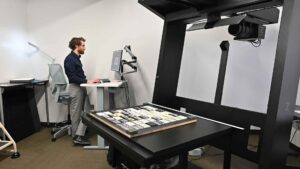
The Center’s current fleet of Crowley-supplied scanners includes:
- Crowley StillShot
- InoTec SCAMAX® 4×3 Document Scanner†
- Zeutschel OS 14000TT (A2)†
- Zeutschel OS HQ
- Zeutschel ScanStudio
The Center’s digitization journey is also marked by continual improvement, with previous Crowley-supplied models replaced as technology advanced:
- Zeutschel OS 10000TT† – replaced by Zeutschel OS 14000 HQ (A0)†
- Zeutschel OS 14000 HQ (A0)† – replaced by the OS HQ
- Zeutschel OS 12002V† – replaced by the OS HQ
Other Baylor University departments, including the Armstrong Browning Library & Museum and the Carroll Library (home to the Texas Collection), have also adopted Zeutschel capture systems, extending high-quality digitization capabilities across campus.
More Than a Vendor: A True Partner
Crowley has become a key partner in Baylor’s mission to preserve and share knowledge. Each system installed has been carefully chosen not only for its technical precision but also for its compatibility with the Riley Center’s digitization workflow.
The widespread use of Zeutschel systems also provides an important operational advantage. Because multiple scanners share the same OmniScan software platform, operators can move easily between systems while maintaining consistent workflows, image quality, and processing efficiency.
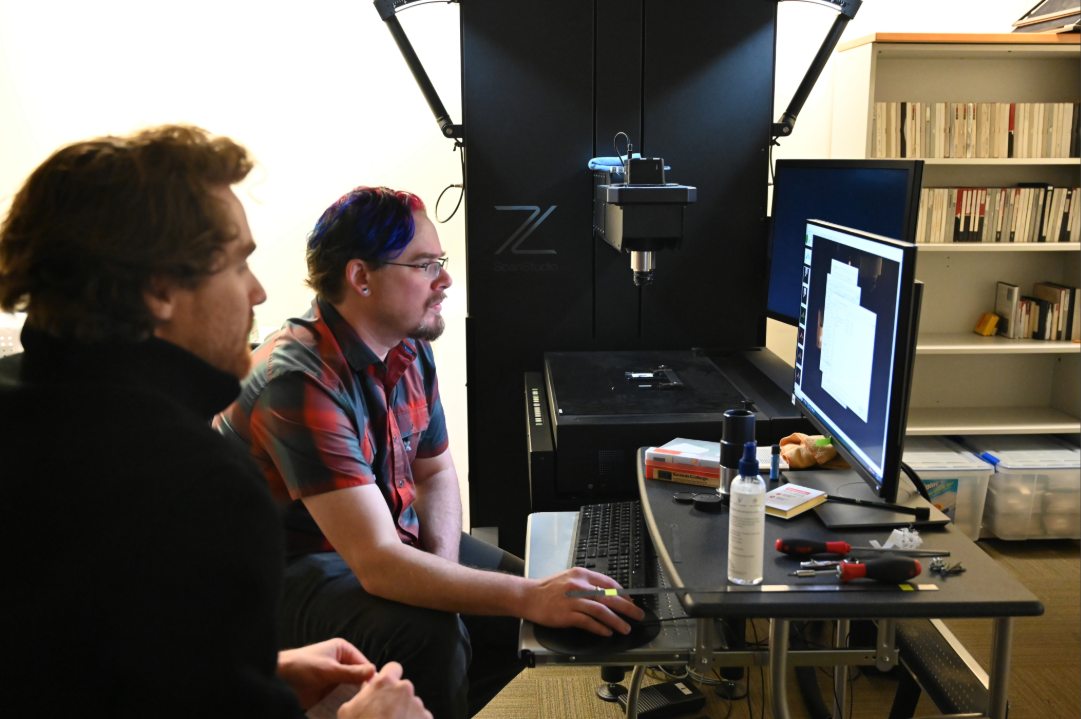
Whenever new equipment is introduced, the Crowley support team works closely with the Riley staff to integrate it into daily operations and ongoing scanning projects. Staff and student operators receive hands-on training, so they quickly become comfortable with new scanners and updates.
Beyond technology, the Riley Center relies on Crowley’s ongoing support and responsiveness. When questions or concerns arise, the support team provides timely, helpful guidance that allows the Riley team to maintain confidence and keep operations running smoothly.
“I’ve never felt uncomfortable reaching out with a dumb question or a concern,” says Taylor. “If something isn’t sounding right or something doesn’t look right, it’s no problem to reach out, and I know that I’ll get a quick and succinct response and usually an answer and a fix in a very short amount of time.”
He adds, “I’ve had conversations with Corin Van de Griek where he’s running late for a flight but still takes the time to make sure that we understand the system… that’s invaluable.”
Impact Across Baylor University Campus and Beyond
The Center’s work has established Baylor University as a leader in cultural preservation, with far-reaching impact. Its flagship project, the Black Gospel Music Preservation Program, received a $2.4 million grant from the Lilly Endowment, Inc in 2025. This funding will help expand the Archive and Listening Center by providing additional space for teaching, research, performances, exhibitions, and the ever-growing physical collection.
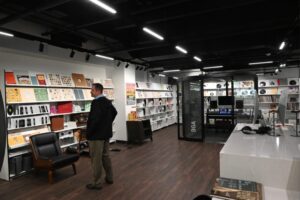
In March 2025, Baylor hosted its first Black Gospel Archive Symposium, a milestone event that celebrated the legacy of Black Gospel music and brought together scholars, students, and the broader community. This gathering underscored the Center’s central role in fostering scholarship, learning, and public engagement around Black sacred music.
Looking Ahead: Continuing the Legacy
The Riley Digitization Center shows no signs of slowing down. Its future goals include achieving Federal Agencies Digital Guidelines Initiative (FADGI) certification, ensuring that its imaging practices meet the highest national standards for archival quality, a milestone they plan to reach with Crowley’s training and support. As Taylor emphasizes, “If you’re thinking quality, you can be very confident that Crowley is going to provide that.”
From humble beginnings with flatbed scanners to becoming a model of digitization excellence, Baylor University’s Ray I. Riley Digitization Center has grown into a cornerstone of cultural preservation. It shows how thoughtful planning, skilled staff, and long-term collaboration turned fragile collections into digital history.
Today, the Riley Digitization Center stands as proof that dedication to preservation, combined with the right technology and best practices, can keep unique collections accessible and meaningful into the future.