The Gift of Speed: C400 Aperture Card Digitization
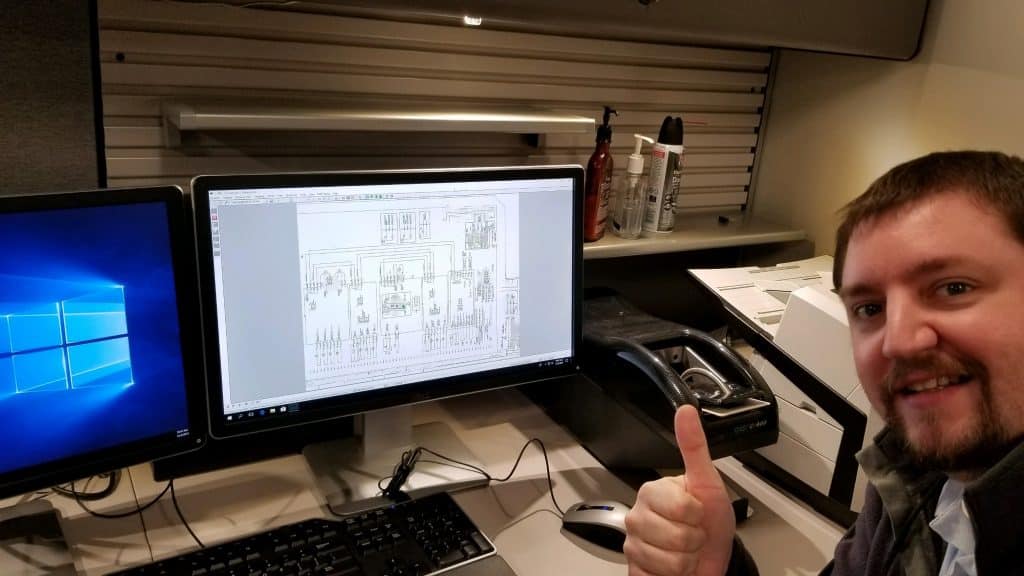
Cohen Anderson, nuclear records specialist for Southern Nuclear, in front of their C400 aperture card scanner.
Technology is a universal hot ticket item for the holidays. For those in the digitization world, it is more than popular, it is necessary. With ever-evolving technology, collection custodians are faced with the task of finding the best scanners with the latest features and image quality while staying within their budget.
Last December, Southern Nuclear, a nuclear energy facility based in Birmingham, AL, found themselves with a 2017 end-of-year budget surplus (something I know nothing about) and contacted The Crowley Company for information on the C400 aperture card scanner to help their records department.
With nearly 100 facilities and plants around the U.S., Southern Nuclear has enough records to fill Santa’s sleigh a few times over. “Each location has at least 50+ years of documents, aperture cards, microfiche and microfilm records with new ones being created daily,” says Cohen Anderson, Southern Nuclear’s corporate nuclear records specialist. “Conceptually, our records sometimes feel similar to the universe, ever expansive!”
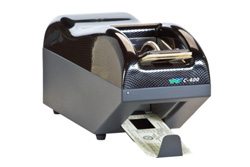
C400 Aperture Card Scanner
The C400 aperture card scanner produces high-quality digital images and hollerith punch data output.
Aperture cards have an impressive history, but in short, the media is chiefly used by those in the industrial and technical fields because it allows large-format materials such as blueprints to be reduced to a small fraction of their original size, written to microfilm and easily stored.
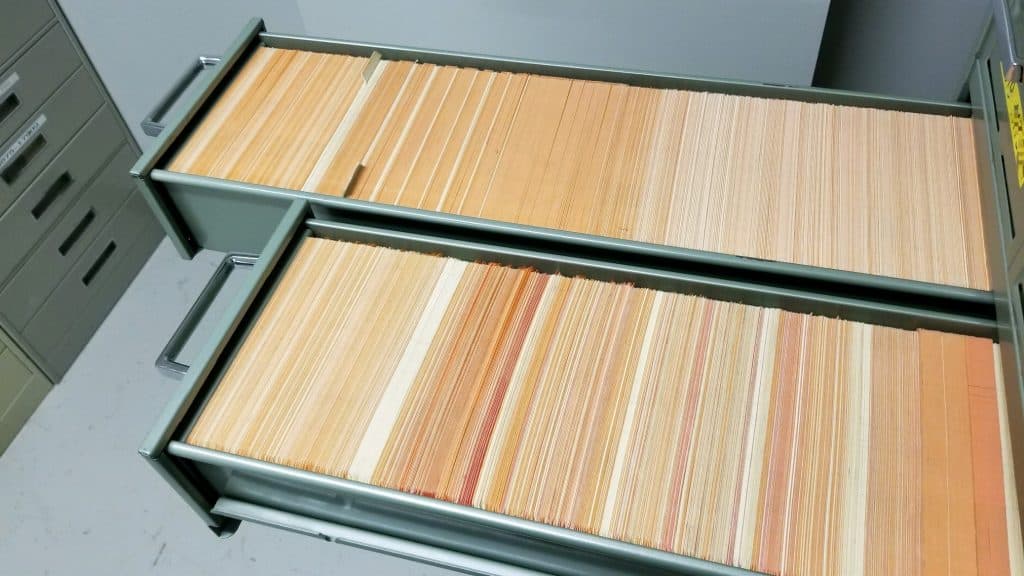
Southern Nuclear’s aperture card collection holds the plant’s civil, mechanical, electrical, piping and instrumentation diagrams and drawings, calculations, correspondence and material lists dating between the 1960s and 1980s. While current records are no longer written to aperture cards, the information in the collection is still used by plant engineers, technicians and other staff. This made creating convenient digital access a priority for the records department, followed closely by the desire for preservation and reduced physical storage.
Just a small preview of the large aperture card collection at Southern Nuclear.
The C400’s batch scanning mode has increased Southern Nuclear’s conversion operation significantly. “It saves a tremendous amount of time for us,” says Anderson. “The Hollerith reading capabilities, which automatically names the files, plus the batch scanning really takes things to another level for us. The C400 has streamlined the entire scanning process.” Before the C400, Southern Nuclear used a single card scanner. With the C400 automated batch scanner, an operator can digitize up to 150 aperture cards at a time while working on other tasks.
The gift of speed and efficiency is one I wish someone would grant me (the Flash is my role model) but it is equally as cool to give someone the gift of an easier day-to-day process.
The Gift That Keeps on Giving
On a large scale, digitization itself gives the world the gift of lasting information and widespread access. Whether preserving family scrapbooks, photo negatives, digitizing microfilmed newspapers for the safeguarding of history or creating digital access to county birth, death, marriage and other records, digitization services and hardware can provide longevity and easy access for public and private collections for generations to come. The Crowley Company is honored to play a part in the exchange.
Share and preserve your collections by finding out more about Crowley scanners or scanning services. Get a quote today.
[Hannah-Clawson]