Beyond the Scan: Taking a Full-Lifecycle Approach to Nuclear Records
If you work with nuclear records, you already know that digitization is rarely as simple as putting documents on a scanner.
Records can span decades and come in just about every format imaginable, such as paper files, engineering drawings, microform, aperture cards and more. Some are used every day, while others may sit untouched for years until someone suddenly needs a specific piece of information.
When that happens, simply having a digital image isn’t enough. Can you find it? Can you read it? Can you trust it? Can you still use it years from now?
Those questions should shape the digitization strategy from the beginning.
Start With Nuclear Records
It can be tempting to start by asking, “What scanner should we buy?” Instead, start with the records.
What formats do you have? What condition are they in? Who will use them? Are they being digitized for preservation, everyday access, regulatory requirements, or a combination?
The answers will help determine the right technology and approach.
A production document scanner may work well for paper records, while microform, fragile materials or oversized drawings may require specialized equipment. For a large backlog or a project involving formats that aren’t routinely handled in-house, outsourcing may be the more practical option.
There isn’t one solution for every collection.
Capture Is Only One Part of the Process

A good digital image is important, but it is not the end goal. Quality control, metadata, indexing, OCR, file formats, storage and access all affect how useful those records will be.
A good example comes from the New York State Historic Newspapers Project, which has spent decades digitizing historic newspapers from microfilm. As the collection grew, the team found that its original scanner could not always produce the image quality needed from older or deteriorating film.
The project eventually turned into The Crowley Company equipment and Mekel Technology Quantum software. The combination gave the team more flexibility to work with challenging film and improve images during post-processing. When the project was later moved to a Crowley MACH Mini Film scanner, which helped streamline the process.
The lesson isn’t really about newspapers. It’s about understanding the material and building the technology around it.
Build a Practical Approach for Nuclear Records
Before production begins, establish image-quality requirements and quality-control procedures. Identifying problems early is far easier than correcting them after thousands or millions of images have been created.
It’s also worth taking an honest look at internal resources.
An organization may have the staff and equipment to handle routine paper records but lack the time or specialized technology needed for microform. Another may benefit from outsourcing a large backlog while keeping ongoing work in-house.
A hybrid approach can provide flexibility without requiring an organization to build expertise for every type of nuclear record.
Look Beyond the Equipment
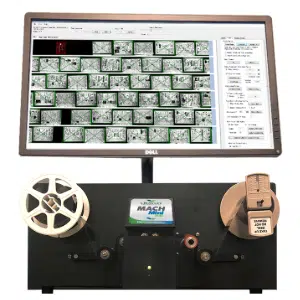
For organizations purchasing digitization equipment, the scanner is only part of the investment. Installation, operator training, maintenance, software and technical support all contribute to keeping production moving.
As requirements change, having access to people who understand both the equipment and the digitization process can become just as important as the initial purchase.
Plan for Long-Term Access for Nuclear Records
Nuclear records often have long retention requirements, so decisions made today can affect how accessible and useful those records remain years from now.
Preservation, metadata, file formats, storage and future migration should be considered early. The same applies to AI and other emerging technologies. Advanced search and AI tools depend on having accurate, accessible information to work with.
Poor-quality images, inconsistent metadata, or inaccessible legacy files can limit what those technologies can accomplish.
A useful way to think about digitization is as a lifecycle:
Assess → Prioritize → Capture → Validate → Organize → Access → Support → Preserve
The exact approach will vary from organization to organization. What matters is considering the entire path rather than treating scanning as the finish line.
Ultimately, success isn’t measured by how many pages or frames were scanned.
It’s measured by whether someone can find the information when they need it, trust what they’re looking at and continue to use it for years to come.
That’s what it means to move beyond the scan.
Author:
 Amanda Carrillo
Director of Marketing and Communications, The Crowley Company
Amanda is passionate and results-driven professional focused on continuously elevating marketing strategy and execution across the organization. Outside of work, she enjoys dancing, hiking, and spending time with family and friends. Amanda is a wine enthusiast and avid foodie who loves immersing herself in different cultures through excursions, food, and travel.